Hallo All,
We arrived in Amsterdam in the time the Nav Chick said it would take. On the drive in Fred did make a comment in the car that we should have made sandwiches from the ham and buns at the breakfast bar for the road. OMG I laughed, you truly are becoming a Brit!!! This is something we have seen done by the Brits in our travels.
Once we checked in at the Novotel, we had a late lunch and found out the easiest way to get to Amsterdam city centre. A free shuttle bus ride to the airport and then a quick train ride takes us right into the centre of town. We decided that it was a good idea to get the lay of the land so we can optimize the time we have in Amsterdam. So off we headed into town. As you all know I can't read a map if my life depended on it and my sense of direction is non-existent. I can safely say that tonight Fred was not much better. We started off by leaving the train station by the nearest door which was our first mistake. The picture in the right hand corner is the train station. We wandered around trying to find the "old side" of Amsterdam.
Amsterdam city centre is divided into four sections and we wanted to see the old side first. Even the TomTom which Fred has was of no use to us, we were not sure if it was the user Fred (LOL) or it just did not recognize the street names. We were standing on a corner looking at the map and two young kids approach us looking for directions. They desperately wanted to get to the Red Light District and I laughed and advised them that we were lost as well, so would be of no help to them. We continued to wander around as Fred tried to find street names and get some sense of direction. Finally, a young man stops and asks if he can help us and points us in the right direction. We finally got the lay of the land and I am tired and in pain so we headed back to the hotel to get rested up and ready to tackle Amsterdam tomorrow.
Dag,
Sandy & Fred
Monday, September 6, 2010
Saturday, September 4, 2010
September 3, 2010 - Antwerp
Bonjour, Goed dag,
The two languages that are spoken in Belgium French and Dutch. This morning we headed into the city centre of Antwerp. It is the largest city in Flanders and is also know as Belgium's second city. Antwerp began as a settlement on the banks of the Scheldt in the 2nd century AD. It then became part of the Duchy of Brabant, and a main port in 1106. Over the next 200 years, it was a thriving hub of the European cloth industry.
The name Antwerp is said to come from the legend of Silvius Brabo (seen to the right) who cut off the hand of an evil giant Druon Antigoon who was extracting heavy tolls on shipping and cut off the hands of captains who could not pay. He threw the hand in the River Scheldt. This handwerpen or hand-throwing is said to be the gesture that gave Antwerp it's name.
Onze-Lieve-Vrouwekathedraal (Cathedral of Our Lady) as seen to the left took almost two centuries to build, from 1352-1521. The tiered spire rises 404 feet above the street. The structure is amazing and the carvings in stone very detailed. From here we walked on to the Grote Markt which is a series of buildings that were once Guild Houses, examples being the crossbowmen and meat guild.
We were able to get to all the sites in Antwerp that we wanted to get to and there was very little tourist traffic. Also none of the stores were open. It is after 10:00 and everything was closed down. We started to wonder whether Friday was a special holiday in the town that we knew nothing about. We discovered that things didn't open till 11:00 a.m. Nice starting hours
but then we don't know how late they work. We enjoyed our short visit in Antwerp and now we are heading off to Amsterdam.
Tot ziens, au revoir ,
Sandy & Fred
The two languages that are spoken in Belgium French and Dutch. This morning we headed into the city centre of Antwerp. It is the largest city in Flanders and is also know as Belgium's second city. Antwerp began as a settlement on the banks of the Scheldt in the 2nd century AD. It then became part of the Duchy of Brabant, and a main port in 1106. Over the next 200 years, it was a thriving hub of the European cloth industry.
The name Antwerp is said to come from the legend of Silvius Brabo (seen to the right) who cut off the hand of an evil giant Druon Antigoon who was extracting heavy tolls on shipping and cut off the hands of captains who could not pay. He threw the hand in the River Scheldt. This handwerpen or hand-throwing is said to be the gesture that gave Antwerp it's name.
We were able to get to all the sites in Antwerp that we wanted to get to and there was very little tourist traffic. Also none of the stores were open. It is after 10:00 and everything was closed down. We started to wonder whether Friday was a special holiday in the town that we knew nothing about. We discovered that things didn't open till 11:00 a.m. Nice starting hours
but then we don't know how late they work. We enjoyed our short visit in Antwerp and now we are heading off to Amsterdam.
Tot ziens, au revoir ,
Sandy & Fred
Thursday, September 2, 2010
September 1 -2, 2010 - Dover
The drive from Liverpool to Dover was uneventful but long for Fred. We thought his cold was getting better but by the time we arrived in Dover he was totally buggered. After a short walk around and some picture taking he crashed for a couple of hours of much needed rest.
The picture in the top right hand corner shows a balcony, window and what I am calling the back door to what we think may be part of the castle that is on top of the cliff. Sure would not want to piss off the hostess or host of this place cause it is a long way down if they show you out the back door. I kind off like that idea myself as I know a few people I would love to show this door to.
Our ferry departed at 10:00 a.m. and we had plenty of time for boarding. As we departed we saw the White Cliffs of Dover in all their magnificence. My first thought was a bit foolish as I thought of how Robin of Lockley must have felt when he rolled onto the beach beneath the cliffs on his returns from the crusades. Yes I know it was only a movie of a mythical character but that was my first thought. More sobering is how the pilots returning from bombing missions must have felt when the White Cliffs came into sight that they made it back to England. Vera Lynn's song also comes to mind when looking upon these amazing cliffs
The ferry ride across the Channel was uneventful. I was hoping for some wave action but maybe on the return voyage. Getting out of Dunkerque (French for Dunkirk) took longer than expected due to congestion and a large amount of truck traffic to get around. Other than that the drive to Antwerp was not stressful at all or that long. Tomorrow we are looking forward to checking out Antwerp's city sites before heading to Amsterdam Holland.
Cheers,
Sandy & Fred
Sunday, August 22, 2010
August 19, 2010 - Stonehenge and The Roman Baths
Greetings all,
Today we headed off to Stonehenge. This is a site that I have wanted to visit since my arrival to the UK.
Fred remembers visiting it as a child and being able to climb on the stones and touch the pillars. This is now a World Heritage Site and is now protected so you can no longer get up close and personal to the remaining stones.
One of the most famous sites in the world, Stonehenge is composed of earthworks surrounding a circular setting of large large standing stones. It is at the centre of the most dense complex of Neolithic and Bronze monuments in England, including several hundred burial mounds. It evolved between 3000 BC and 1600 BC. The stones are aligned with the midsummer sunrise and the midwinter sunset. However, the monuments exact purpose still remains a mystery. It is strangely, a quite place even with the number of tourists around, even the kids are quite. Certainly a mystical and mythical place to those who visit.
We took a different route when we headed back to Bath and stopped at a quaint pub, The Prince of Wales in Dunkerton Hill Bath, for lunch. We both had chicken burgers and our usual 1/2 pint and pint drinks. Refreshed we carried on back to Bath and our hotel to drop off the car and then walked into town to visit The Roman Baths.
The first shrine at the hot springs was built by the Celts and was dedicated to the goddess Sulis, who the Romans identified with Minerva. The name Sulis continued to be used after the Roman invasion leading to the town's Roman name of Aquae Sulis (literally, "the waters of Sulis"). The temple was constructed in 60-70 AD and the bathing complex was gradually built up over the next 300 years. After the fall of the Roman Empire the baths fell into disrepair and then lost due to silting up and flooding. Much of the baths are now below street level and have been built over during the centuries that followed. The Baths went through a series of redevelopment during the
12th century when John of Tours built a curative bath over the King's Spring reservoir and in the 16th century when the city corporation built a new bath (Queen's Bath) to the south of the Spring. The spring is now housed in eighteenth century buildings, designed by architects John Wood the Elder and John Wood the Younger, father and son. Visitors drank the waters in the Grand Pump Room, a neo-classical salon which remains in use today, both for taking the waters and for social functions. Victorian expansion of the baths complex followed the neo-classical tradition established by the Woods.
Excavations of the site still continues today and many artifacts from the Roman era have been uncovered. Attached is a picture of the gilt bronze head of the goddess Sulis Minerva. The bath's water come out of the springs at a temperature of 46C. The baths were in use up until 1979 when a young girl, after swallowing some water, died five days later of amoebic meningitis. It was closed and remains closed today. A new Spa has been opened and the therapeutic qualities of the water can now be enjoyed. Should we return I will make sure to pack our swim suits so we can enjoy the spa. I must say however that with today's technology it is a shame that they cannot re-open the old spa or at least clean up the waters of the old spa you see in the blog.
After our visit to the Roman Baths we took our last walk up the hill to the hotel for our last night in Bath. The trip has been one of our best yet and was a great way to celebrate our 37th wedding anniversary.
Check out our Flickr site (www.flickr.com/photos/fredparkins) later in the week when hopefully Fred will have our pictures posted.
Ta Ra for now until September when we go on our next adventure.
Sandy & Fred
Today we headed off to Stonehenge. This is a site that I have wanted to visit since my arrival to the UK.
Fred remembers visiting it as a child and being able to climb on the stones and touch the pillars. This is now a World Heritage Site and is now protected so you can no longer get up close and personal to the remaining stones.
One of the most famous sites in the world, Stonehenge is composed of earthworks surrounding a circular setting of large large standing stones. It is at the centre of the most dense complex of Neolithic and Bronze monuments in England, including several hundred burial mounds. It evolved between 3000 BC and 1600 BC. The stones are aligned with the midsummer sunrise and the midwinter sunset. However, the monuments exact purpose still remains a mystery. It is strangely, a quite place even with the number of tourists around, even the kids are quite. Certainly a mystical and mythical place to those who visit.
We took a different route when we headed back to Bath and stopped at a quaint pub, The Prince of Wales in Dunkerton Hill Bath, for lunch. We both had chicken burgers and our usual 1/2 pint and pint drinks. Refreshed we carried on back to Bath and our hotel to drop off the car and then walked into town to visit The Roman Baths.
The first shrine at the hot springs was built by the Celts and was dedicated to the goddess Sulis, who the Romans identified with Minerva. The name Sulis continued to be used after the Roman invasion leading to the town's Roman name of Aquae Sulis (literally, "the waters of Sulis"). The temple was constructed in 60-70 AD and the bathing complex was gradually built up over the next 300 years. After the fall of the Roman Empire the baths fell into disrepair and then lost due to silting up and flooding. Much of the baths are now below street level and have been built over during the centuries that followed. The Baths went through a series of redevelopment during the
12th century when John of Tours built a curative bath over the King's Spring reservoir and in the 16th century when the city corporation built a new bath (Queen's Bath) to the south of the Spring. The spring is now housed in eighteenth century buildings, designed by architects John Wood the Elder and John Wood the Younger, father and son. Visitors drank the waters in the Grand Pump Room, a neo-classical salon which remains in use today, both for taking the waters and for social functions. Victorian expansion of the baths complex followed the neo-classical tradition established by the Woods.
Excavations of the site still continues today and many artifacts from the Roman era have been uncovered. Attached is a picture of the gilt bronze head of the goddess Sulis Minerva. The bath's water come out of the springs at a temperature of 46C. The baths were in use up until 1979 when a young girl, after swallowing some water, died five days later of amoebic meningitis. It was closed and remains closed today. A new Spa has been opened and the therapeutic qualities of the water can now be enjoyed. Should we return I will make sure to pack our swim suits so we can enjoy the spa. I must say however that with today's technology it is a shame that they cannot re-open the old spa or at least clean up the waters of the old spa you see in the blog.
After our visit to the Roman Baths we took our last walk up the hill to the hotel for our last night in Bath. The trip has been one of our best yet and was a great way to celebrate our 37th wedding anniversary.
Check out our Flickr site (www.flickr.com/photos/fredparkins) later in the week when hopefully Fred will have our pictures posted.
Ta Ra for now until September when we go on our next adventure.
Sandy & Fred
August 18, 2010- Cheddar Gorge and Wells
Greetings All,
Today we first headed off to Cheddar Gorge that was formed during the last ice age. The gorge itself is located in the Mendip Hills. The limestone walls are 140 metres or 450 feet above the road. The caves in the gorge are near the lower end of it, where one of the largest underground rivers in Britain resurges to the surface through 18 separate springs. The river, the Cheddar Yeo has a average flow of one cubic metre per second. In the 16th century it powered seven watermills one above the other in Cheddar.
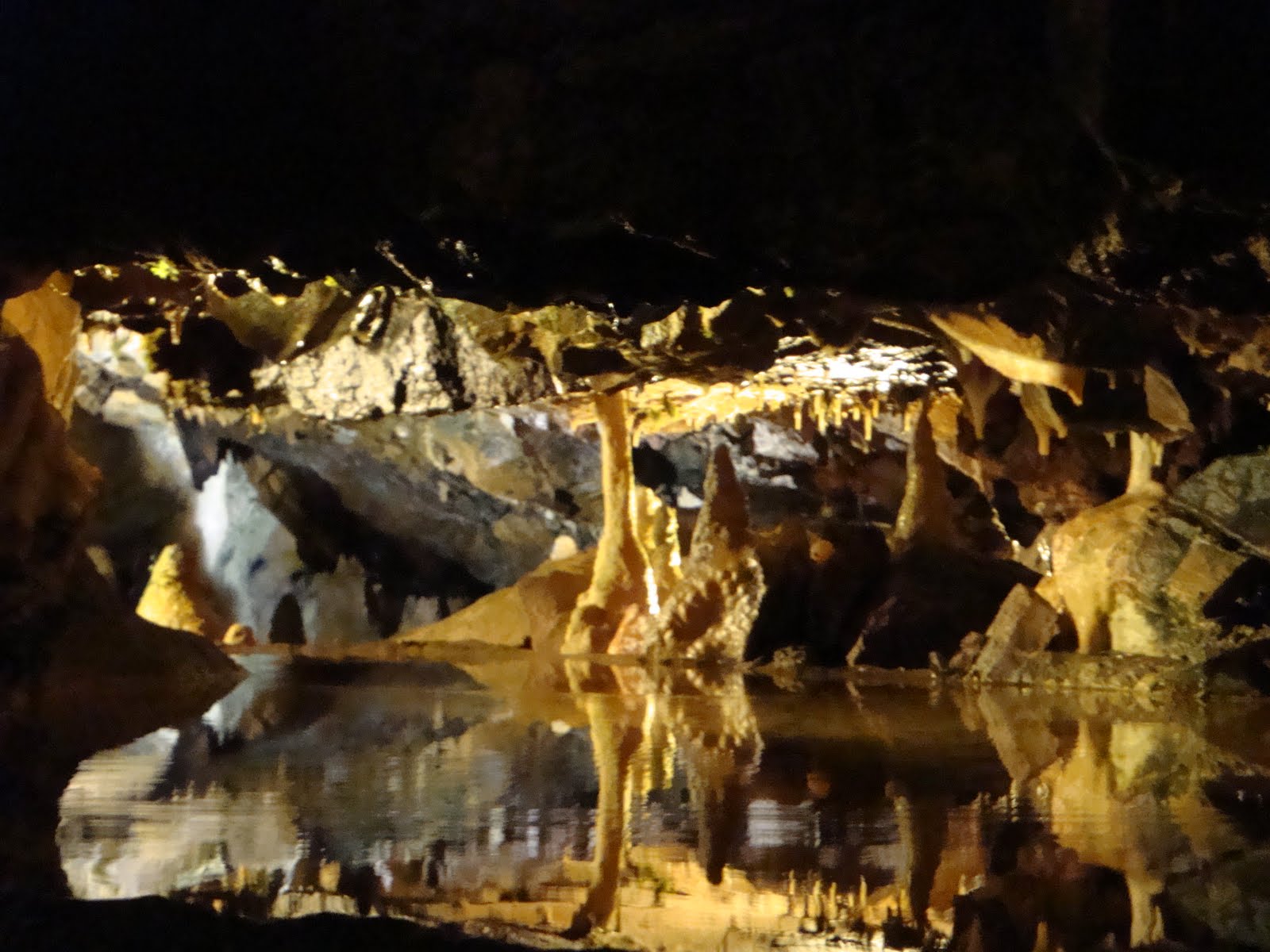
We took a short bus tour around the gorge which provided explanations about its formation and the wildlife in the area, some that has been reintroduced on purpose such as a rare breed of British Primitive goats to browse off the scrub and sheep which someone dropped off in the hills and are thriving. The first cave we entered was Gough's Cave. Richard Cox Gough, a retired sea captain came to Cheddar in 1870. He worked at the Charterhouse lead works and in his spare time dug in the small caves of the gorge hoping to find a cave like his uncles, Cox's Cave, that was opened to the public. In 1887 he obtained control over a minor cave which he improved and is known as Gough's Old Cave. In 1890 at the age of 63 he started digging at the end of a short cave at the foot of the cliff. This is Gough's Cave today. It soon became evident that efforts were leaing him into passages bigger than any yet discovered in Cheddar. The picture on the left is a reflection pool of stalactites and stagmites. In1898 Richard made his greatest discovery the St Paul's Chamber, the picture on the right.
The pictures on here really don't do justice to what we saw in the cave. The cave is also the site of the now famous Cheddar Man. He was discovered in 1903 and radiocarbon dating show that the bones are about 9000 years old.
Cox's Cave also has some amazing formations but you will have to check out my Facebook pictures that are already posted or our Flickr site (Fred is still to post) to see these. Exploration of the caves still continues today with cave diving. In 1985 a cave diver discover a passage way, 500 metres of submerged galleries and a huge dry cavern.
The other thing Cheddar is famous for is Cheddar Cheese. I had the best ham and cheddar cheese Ploughman's lunch at The White Hart a quaint pub in Cheddar. Fred had a Steak and Ale Pie.
After lunch we headed into Wells to see the Cathedral Church of St Andrew. The cathedral in Wells is also the cathedral for Bath which is 18 miles away. Due to disagreements on where to build the cathedral, a neutral site was picked by the bishop of the time. Built in 1230, the West Front contains one of
the largest galleries of medieval sculpture in the world. It is an illustration in stone of the Christian faith. Starting in the lower niches with biblical scenes, it rises through kings, bishops, order of angles to the twelve apostles with Christ over all. This picture does not really do the magnificence of the carving any justice but when you visit our flickr site you can see the detail involved in the stone work. You are permitted to take pictures inside the Cathedral provided you purchase a "photographic permit". Since Fred's camera is superior to mine he took the pictures in the Cathedral. The inside was just as beautiful as the outside even though the cathedral did not have many stained glass windows as we have seen in other cathedrals. In the Nave you are drawn to the unique scissor arches seen here. Built in 1338-48 it was a medieval solution to sinking tower foundations.
Another wonderful feature we came upon was the Wells clock. It was installed in 1392 and is considered the second oldest original working clock in the world and the oldest with its original dials. The knights at the top of the clock joust every quarter of a hour with the same knight being knocked over for the last 600 years. The figure of Jack Blandifer strikes the bell with his heel every quarter of the hour and a hammer on the hour. We do not know who or of what significance Jack was to the church or the clock and have not found anything on Wikipedia
I could go on for pages about the cathedral which we spent about one and a half hours in exploring. The last picture I have for this blog is of the Altar and its beautiful covering. It appeared as it had light shining out of the covering but did not. The effect was from the needlework and the golden threads used in depicting the golden sunlight on the water.
Finally back at the hotel we had a wonderful meal to celebrate our anniversary. Pan Fried Duck Breast, with roast potato slices, veggies and a nice bottle of Rancho Zabaco a Californian Zinfandel as they did not have any Italian wines, finished off with a chocolate pudding that we thought was a molten chocolate cake but turned out not to be so was a little disappointing. We had a fantastic day and saw some amazing sites.
Cheerio for now,
Sandy & Fred
Today we first headed off to Cheddar Gorge that was formed during the last ice age. The gorge itself is located in the Mendip Hills. The limestone walls are 140 metres or 450 feet above the road. The caves in the gorge are near the lower end of it, where one of the largest underground rivers in Britain resurges to the surface through 18 separate springs. The river, the Cheddar Yeo has a average flow of one cubic metre per second. In the 16th century it powered seven watermills one above the other in Cheddar.
We took a short bus tour around the gorge which provided explanations about its formation and the wildlife in the area, some that has been reintroduced on purpose such as a rare breed of British Primitive goats to browse off the scrub and sheep which someone dropped off in the hills and are thriving. The first cave we entered was Gough's Cave. Richard Cox Gough, a retired sea captain came to Cheddar in 1870. He worked at the Charterhouse lead works and in his spare time dug in the small caves of the gorge hoping to find a cave like his uncles, Cox's Cave, that was opened to the public. In 1887 he obtained control over a minor cave which he improved and is known as Gough's Old Cave. In 1890 at the age of 63 he started digging at the end of a short cave at the foot of the cliff. This is Gough's Cave today. It soon became evident that efforts were leaing him into passages bigger than any yet discovered in Cheddar. The picture on the left is a reflection pool of stalactites and stagmites. In1898 Richard made his greatest discovery the St Paul's Chamber, the picture on the right.
The pictures on here really don't do justice to what we saw in the cave. The cave is also the site of the now famous Cheddar Man. He was discovered in 1903 and radiocarbon dating show that the bones are about 9000 years old.
Cox's Cave also has some amazing formations but you will have to check out my Facebook pictures that are already posted or our Flickr site (Fred is still to post) to see these. Exploration of the caves still continues today with cave diving. In 1985 a cave diver discover a passage way, 500 metres of submerged galleries and a huge dry cavern.
The other thing Cheddar is famous for is Cheddar Cheese. I had the best ham and cheddar cheese Ploughman's lunch at The White Hart a quaint pub in Cheddar. Fred had a Steak and Ale Pie.
After lunch we headed into Wells to see the Cathedral Church of St Andrew. The cathedral in Wells is also the cathedral for Bath which is 18 miles away. Due to disagreements on where to build the cathedral, a neutral site was picked by the bishop of the time. Built in 1230, the West Front contains one of
the largest galleries of medieval sculpture in the world. It is an illustration in stone of the Christian faith. Starting in the lower niches with biblical scenes, it rises through kings, bishops, order of angles to the twelve apostles with Christ over all. This picture does not really do the magnificence of the carving any justice but when you visit our flickr site you can see the detail involved in the stone work. You are permitted to take pictures inside the Cathedral provided you purchase a "photographic permit". Since Fred's camera is superior to mine he took the pictures in the Cathedral. The inside was just as beautiful as the outside even though the cathedral did not have many stained glass windows as we have seen in other cathedrals. In the Nave you are drawn to the unique scissor arches seen here. Built in 1338-48 it was a medieval solution to sinking tower foundations.
Another wonderful feature we came upon was the Wells clock. It was installed in 1392 and is considered the second oldest original working clock in the world and the oldest with its original dials. The knights at the top of the clock joust every quarter of a hour with the same knight being knocked over for the last 600 years. The figure of Jack Blandifer strikes the bell with his heel every quarter of the hour and a hammer on the hour. We do not know who or of what significance Jack was to the church or the clock and have not found anything on Wikipedia
Finally back at the hotel we had a wonderful meal to celebrate our anniversary. Pan Fried Duck Breast, with roast potato slices, veggies and a nice bottle of Rancho Zabaco a Californian Zinfandel as they did not have any Italian wines, finished off with a chocolate pudding that we thought was a molten chocolate cake but turned out not to be so was a little disappointing. We had a fantastic day and saw some amazing sites.
Cheerio for now,
Sandy & Fred
Friday, August 20, 2010
August 17, 2010 - Bath
Greetings All,
Today we spent exploring Bath, designated a Unesco World Heritage Site in 1987. The symbol you see here is the World Heritage Symbol and was placed at the centre of the original town. Bath has the distinction of being the only city with a World Heritage Site designation in the UK. We walked to the Abbey Churchyard and joined a free two hour walking tour of Bath. Our guide, Terry was very informative providing us with some of the city's background history. The city was established as a spa resort by the Romans in AD 43 with name Aquae Sulis ("the waters of Sulis"), utilizing the natural hot springs of the area. There is also archeological evidence that the valley in which Bath is situated was populated well before the Romans conquered England. Bath sits in a valley, surrounded by seven hills so the Romans of the day must have felt right at home in Aquae Sulis. After the fall of the Roman Empire Bath became just another small dirty city until the Georgian period when Queen Anne visited the city in 1702. After her visit the rich and famous of London visited to see what Bath was all about. The medicinal properties of the Bath's 3 hot springs was also growing at this time. As the city did not have the housing or entertainment for the well-heeled from London, a building boom took place.
An architect by the name of John Woods created amazing buildings to house the London aristocracy outside of the city's walls as there was no room to build within them. Attached is a picture of a John Woods building in Queens Square. Queens Square and The Circus are the masterpieces attributed to him. His son was also an architecture and was also named John Woods and his masterpiece is the Royal Crescent.
Both of the Woods' based their designs on the Palladian style of architecture from Italy with symmetry, columns and triangles in the upper parts of the structures. Almost all of the city is constructed of Bath Stone which is a soft limestone that is quarried in the area. We learnt that the stone can be cleaned but the process takes six months. The house must be sealed and water is then cascaded over the stone for this period then lightly brushed. The city pays the owner half the cost of the cleaning, however, we do not find out how expensive this is. Once cleaned the stone appears like new and doesn't have to be cleaned again for 40 -50 years. As the city is a World Heritage site all home owners are encouraged to have their homes cleaned. During the 1700's Beau Nash took advantage of the new growth and arranged for himself to become the Master of Ceremonies for Bath, which required him to arrange a schedule of entertainment for those who came to Bath as it was the the Place to be seen. He was a gambler and arranged for some of the entertainment to include his favorite pastime. He never married but had seven mistresses and lived to a ripe old age of 86 something unheard of in that time period or at least a very rare occurrence.
After our tour we had a light lunch of Duck Spring Rolls and a 1/2 pint of cider for me and pint of bitter for Fred at The Crystal Palace a pub near the Abbey. Our next stop was the Abbey. Its full title is Bath Abbey Church of St. Peter and St. Paul. We were lucky enough to hear an organ recital in progress as we entered, so we sat and enjoyed the music being played from the amazing Pipe Organ. I have posted on Facebook a video
of the music as well as some pictures. Once again the architecture of the Abbey is mind boggling when you take into consideration when the structure was built and the tools used. The original Abbey was founded in the 8th century then rebuilt as a Norman Cathedral in the 11th century. This fell into disrepair and commencement of building the present Abbey church was begun in 1499. The organ we saw today was installed in 1895 and was totally refurbished in 1997 to its 1895 condition.
After our tour of the Abbey we set off to other city sites. The only disappointment for us was the fact there was a fee to enter the park by the river Avon. It was not a lot, but totally unnecessary in our opinion. The people manning the station looked scrubby and for all we know were taking advantage of the tourists. Britain's annual Cities in Bloom floral competition is under way, which Bath has won 14 out 40 times and hopes to win again this year. As mentioned earlier Lions are the theme of the city this year and attached is a picture of the ultimate floral sculpture King of the Pride. There is so much that we wish to share about our day today but I am afraid it would take too many pages. Today for us has been informative, enlightening and we have only scratched the surface of Bath.
Cheerio for now,
Sandy & Fred
Today we spent exploring Bath, designated a Unesco World Heritage Site in 1987. The symbol you see here is the World Heritage Symbol and was placed at the centre of the original town. Bath has the distinction of being the only city with a World Heritage Site designation in the UK. We walked to the Abbey Churchyard and joined a free two hour walking tour of Bath. Our guide, Terry was very informative providing us with some of the city's background history. The city was established as a spa resort by the Romans in AD 43 with name Aquae Sulis ("the waters of Sulis"), utilizing the natural hot springs of the area. There is also archeological evidence that the valley in which Bath is situated was populated well before the Romans conquered England. Bath sits in a valley, surrounded by seven hills so the Romans of the day must have felt right at home in Aquae Sulis. After the fall of the Roman Empire Bath became just another small dirty city until the Georgian period when Queen Anne visited the city in 1702. After her visit the rich and famous of London visited to see what Bath was all about. The medicinal properties of the Bath's 3 hot springs was also growing at this time. As the city did not have the housing or entertainment for the well-heeled from London, a building boom took place.
An architect by the name of John Woods created amazing buildings to house the London aristocracy outside of the city's walls as there was no room to build within them. Attached is a picture of a John Woods building in Queens Square. Queens Square and The Circus are the masterpieces attributed to him. His son was also an architecture and was also named John Woods and his masterpiece is the Royal Crescent.
Both of the Woods' based their designs on the Palladian style of architecture from Italy with symmetry, columns and triangles in the upper parts of the structures. Almost all of the city is constructed of Bath Stone which is a soft limestone that is quarried in the area. We learnt that the stone can be cleaned but the process takes six months. The house must be sealed and water is then cascaded over the stone for this period then lightly brushed. The city pays the owner half the cost of the cleaning, however, we do not find out how expensive this is. Once cleaned the stone appears like new and doesn't have to be cleaned again for 40 -50 years. As the city is a World Heritage site all home owners are encouraged to have their homes cleaned. During the 1700's Beau Nash took advantage of the new growth and arranged for himself to become the Master of Ceremonies for Bath, which required him to arrange a schedule of entertainment for those who came to Bath as it was the the Place to be seen. He was a gambler and arranged for some of the entertainment to include his favorite pastime. He never married but had seven mistresses and lived to a ripe old age of 86 something unheard of in that time period or at least a very rare occurrence.
After our tour we had a light lunch of Duck Spring Rolls and a 1/2 pint of cider for me and pint of bitter for Fred at The Crystal Palace a pub near the Abbey. Our next stop was the Abbey. Its full title is Bath Abbey Church of St. Peter and St. Paul. We were lucky enough to hear an organ recital in progress as we entered, so we sat and enjoyed the music being played from the amazing Pipe Organ. I have posted on Facebook a video
of the music as well as some pictures. Once again the architecture of the Abbey is mind boggling when you take into consideration when the structure was built and the tools used. The original Abbey was founded in the 8th century then rebuilt as a Norman Cathedral in the 11th century. This fell into disrepair and commencement of building the present Abbey church was begun in 1499. The organ we saw today was installed in 1895 and was totally refurbished in 1997 to its 1895 condition.
After our tour of the Abbey we set off to other city sites. The only disappointment for us was the fact there was a fee to enter the park by the river Avon. It was not a lot, but totally unnecessary in our opinion. The people manning the station looked scrubby and for all we know were taking advantage of the tourists. Britain's annual Cities in Bloom floral competition is under way, which Bath has won 14 out 40 times and hopes to win again this year. As mentioned earlier Lions are the theme of the city this year and attached is a picture of the ultimate floral sculpture King of the Pride. There is so much that we wish to share about our day today but I am afraid it would take too many pages. Today for us has been informative, enlightening and we have only scratched the surface of Bath.
Cheerio for now,
Sandy & Fred
Tuesday, August 17, 2010
Auust 16, 2010 - Off To Bath
We headed off to Bath for a 4 day break to celebrate our anniversary. We took the back roads but with a few minor detours due to the nav chic giving some wrong directions and Fred also making a couple of wrong turns. The plus side of this was we got to see some amazing countryside and homes in some towns that we would have never seen otherwise.
We arrived in Bath, pronounced Barth by the locals, very posh as they say. Our hotel, the attached picture, the Lansdown Grove is part of the architectural history of Bath and one of the oldest in the city. In 1884 it was a private residence that comprised a Mansion, stables for 10 horses, coach house, harness room, cart room, mans room and lofts, plus six acres of land. The hotel was for many years privately owned until the early 1990's when it was sold and underwent a major refurbishment.
Once we settled, we took a walk into the downtown area of Bath to check things out for the next day. The walk is as the say a quick 10 minutes into town as it is all down hill. We got the lay of the land and found the main features that we want to visit tomorrow. The Abbey, the Roman Baths and Pump House and where the City Sightseeing bus tour leaves from. The city like others in the UK uses sculptures to promote and raise funds for charity by local artists. Bath has adopted "Lions" this year and last year had pigs. These are then auctioned off usually for 100 to 200 pounds and the fund given to charity.
Last year the 100 pigs were auctioned off for an amazing amount of 380,000 pounds. We then headed back to the hotel and let me tell you the walk back is way more then 10 minutes. Uphill all the way. Plus I did not wear shoes that were good for walking, so we stopped for some revitalization at a pub, The Old Farmhouse where I have a full pint of the best cider I have had yet in the UK, Thatcher's Gold Somerset Cider and Fred had a pint of 6X, a bitter. Fortified we finished the last half of our climb to the hotel.
Supper which is included is quite good. There are some supplements or extras which you pay for but all quite reasonable. We felt rather young as there was quite the geriatric crew in, as a bus tour had booked into the hotel and we had picked a late sitting for supper. All in all a great arrival to Bath.
Cheerio,
Sandy & Fred
Subscribe to:
Posts (Atom)